



By Shola Fadeyi
The Nigerian Shippers’ Council (NSC) has pledged to take steps to address the issues of the rejection of Nigerian agricultural produce in foreign countries, as well as the diversion of cargoes to other neighbouring countries, as part of its contributions to achieving the Federal Government’s agenda’ as it relates to the marine and blue economy sector.
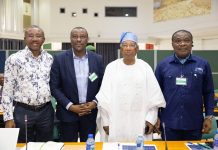
The Council’s Executive Secretary/ CEO, Barrister Pius Akutah made the pledge in an address he delivered in his capacity as the Chairman of the Seminar, titled, ‘Renewed Hope Agenda: The Place of the Nigerian Maritime Industry / AGM organized, by the League of Maritime Editors{LME) at the Airport Hotel, Lagos, over the weekend.
According to Akutah, the Council has begun to engage with the Standards Organisation of Nigeria(SON), the National Agency for Food & Drug Administration and Control( NAFDAC),and other relevant stakeholders with a view to tackling the challenge, associated with the Nigeria agricultural produce in foreign lands.
He explained that the Shippers’ Council is engaging the shipping companies and terminal operators on the need to establish fair and competitive tariff, in order to forestall the diversion of cargoes to other neighbouring countries.
The Shippers’ Council’s boss stated that the Council is also intervening , in the area of the sensitisation and training of stakeholders to encourage the adoption of international best practice in doing their business transactions.
He said the Council is is also engaged with the establishment of Border Information Centres(BICs) at official borders across the country, adding that the organization has four operational BICs located at Seme-Krake border, Jibia-Maradi border, Illela border, and Mfum border.
According to him , another measure, that has been adopted by the Council, include the establishment of a complaint handling and dispute resolution mechanism, for mitigation and out of court settlement between shipping service providers and users.
He said the Council is also promoting and facilitating the establishment of Inland Dry Ports( IDPs) across the country, to ensure that shipping services reach the door steps of shippers that are located at the hinterland areas, and assists in evacuation of transit trade to landlocked countries.
Akutah disclosed that other interventions of the Council , are the promotion and facilitation of the establishment of Vehicle Transit Areas( VTAs) to serve as a resting place for truck drivers and other road users and setting guidelines for tariff and stakeholders’ standard operating procedures, and cost moderation.
He however pledged that the Shippers’ Council will continue to promote and advocate for full digitalisation of port process and operations in Nigerian ports, in line with the Federal Government’s “Renewed Hope” and its mandate as the nation’s port economic regulator, adding that over 90% of Nigerian port process and operations are now automated.
Akutah pointed out that trade between African countries is more expensive compared with trading with other parts of the world, due to what it termed several bottlenecks such as poor infrastructure, cumbersome border procedures, trade restriction, arbitrary tariff, and high cost of doing business in general.
He said the League event is the expected platform to discuss and recommend remedial measures to correct such identified trade abnormalities, with a view to encouraging increase in international trade.
Akutah explained that the topic ,“ Renewed Hope Agenda: The Place of Nigeria’s Maritime Industry”, chosen for the Council was carefully selected , to explore the areas that the League and stakeholders could contribute in achieving the Federal Government’s agenda.
He said that a cardinal part of the 8-point agenda of the Tinubu’s administration to revamp the economy directly as related to the Marine and Blue economy sector is in the area of enhanced infrastructure and transportation as enablers of growth.