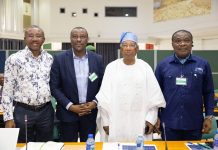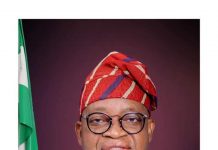



The Executive Secretary/ CEO, of the Nigerian Shippers’ Council (NSC), Barrister Pius Akutah was a year in office recently SHOLA FADEYI had an interview with him, where he spoke on issues , ranging from his experience in office, savings made for the economy, facilitation of construction of Inland Dry Ports(IDPs) , the review of the Shippers’ Council Act , Partnerships, ICTN, insurance risks among others, saying that his one year in office, has recorded Landmark for the Shippers’ Council. Excerpts:-
The Nigerian Shippers’ Council (NSC), is exploring investment opportunities in the blue economy sector including partnership with the Canadian government to enable Nigeria benefit from training and investment.
I actually attended a business and investment forum in Canada, where we are trying to woo the government of Canada to go into investment in the blue economy sector of Nigeria.
Partnership
Canada has a very mature blue economy, which is working for them and we realize that if we have that kind of partnership with the Canadian government to benefit from training, for instance, and some other modes of investment in the blue economy sector, it will also help us to move faster as we establish ourselves in the blue economy.
AfCFTA
Today, we are under the African Free Continental Trade Area Agreement, which means that Nigerian borders are open to the rest of Africa for trade and commerce. So what do we do if we fold our arms and just sit and watch? The whole of Africa will flood our markets with their goods, and it’s important for us to see what we can do.
Protection
So this partnership, beyond the issue of training, capacity building, regulations, and all of that, it will be very important to us if we can also look at areas of investment to woo other sectors to come into Nigeria to invest in the country’s Marine and Blue economy sector. AfCFTA agreement provides an opportunity for Nigeria to push towards becoming the logistics hub in the region ,but proactive measures must be put in place to protect the country from becoming a dumping ground.
Challenges
My first year in office is one that I will live to remember for the rest of my life. It was very challenging I must say. I came in on November 1, 2023 and by December of the year there was a new policy of 50 percent automatic deduction of internally generated revenue (IGR) of all agencies and MDAs.
Just being barely a month on the saddle, that policy hit us very hard. Being an agency that receives handouts from the government, we plan quarterly with whatever allocation that comes to us. We just got allocation for the fourth quarter of the year in December and we started planning with it up to February. Before you know it, in December the policy came and wiped out all the money we had planned with. There was a new account for us that gave us zero balance.
With a staff strength of close to 500, there was no money to pay salaries and so we had to contend with how to manage the situation so that the staff would not go on strike.
Trust
It was very challenging. Thank God we were able to navigate our way through. Nobody went on strike, The staff were happy because when I came in December, most of what was owed them, the outstanding commitments, was cleared immediately the allocation came.
As a result, the workers trusted me and kept calm until they were able to go through the period. That was the baptism of fire that I received. We continued and began stakeholders’ engagement.
Milestone
Despite the challenges , I recorded some notable milestone within my first year in office such as the completion and commissioning of the inland dry port in Funtua, Katsina State in line with the directive of Mr President which was handed over to me by the minister of marine and blue economy when I signed a Performance Bond with him. I will say it has been an eventful year. There are a lot of success stories that I recorded and I think I can say it is a successful year.
Inland Dry Ports
The Funtua inland dry port was one of the top most things on that performance bond factor and it will grow the economy faster.
It is also interesting that we were able to meet up with our KPI as signed under the performance bond with the Ministry of Marine and Blue Economy in the completion and inauguration of the Funtua Inland Dry Port within time. Now, shortly after the inauguration of the Inland Dry Port in Funtua, the Minister of Marine and Blue Economy mandated us to, within the year in focus, ensure that we also take steps in completing the other inland dry ports.
But as at the time this was done, various IDPs, like Isiala Ngwa (Abia state) and many others, were at different degrees of completion. None of them was above 10%, unless some other ones like the one in Jos, which had started. The one in Borno hadn’t started. But there was another private arrangement for a new investor to work together with the concessionaire to start that in a different location, because the location where the land was awarded is still within the control of insurgents. So, it will not be possible for that to go on.
Inspection
Within the last one year, we have visited almost all the IDPs that are pending, including the one of Isiala Ngwa. And we’ve had a series of meetings with the respective Governors of these states to discuss the state of these inland dry ports.
Concerning the one in Borno, the governor even visited the Nigerian Shippers’ Council, and we had an interaction with him in that regard.. He has promised to swing into action and he gave us a deadline within which he could complete the inland dry port. If the two parties are able to consummate an agreement, we bring them together to work in a partnership.
We had a series of discussions ongoing. We also visited Kano. We were at the inland dry port, both the one of Kano and Kaduna. We were there to strengthen the work that they are doing, to give them the needed support, to also ensure that we continue to project the presence of those critical maritime infrastructures in the hinterlands for people who are treading around those areas to use them, so that they become efficient.
Legislation
In the last year, the Nigerian Shippers’ Council has made significant strides towards transforming the maritime sector as part of our milestone in that year. We have managed to push forward initiatives that many considered critical to the progress of our sector.
The NSC currently operates under a 1978 law, which is now obsolete and is not going to adequately provide for what the sector stands for at the moment. So we felt there is a need for us to look into that law and see what we can do to change the law and empower the agency to do more of what is required of it in this 21st century as the port economic regulator.
Empowerment
Now, the Nigerian Shippers’ Council has a bill before the National Assembly seeking to transmute into a regulatory agency by law. The agency at the moment is empowered by a presidential directive and a regulation for it to assume the duties of the Port Economic Regulator, which the agency has been carrying out. But a nitty-gritty of what the Port Economic Regulator will do is not provided in that presidential order and the guidelines. So there is a need for us to have a legislation.
We have that legislation ongoing for some time now. Luckily for us, the National Assembly, the House of Reps has passed it. It’s before the Senate now. So many areas of collaboration with stakeholders will be very necessary and needed as soon as that law is passed into law and assented to by Mr. President.
Enforcement
The Bill when it becomes an Act , will make the Nigerian Shippers Council to transmute into the Nigerian Shipping and Ports Regulatory Agency , which will be able to enforce its powers as an economic regulator , sanction erring stakeholders in the seaport sector , check all forms of arbitrariness, and illegal increase in charges by shipping companies and terminal operators and as such be in position to facilitate trade better.
Benefits
The importance of the successful review of the Shippers Council Act will also make it possible for the Agency to harmonise the Nigerian trade laws with those of other countries in Africa, and put it in a better position to monitor minimum standard for shipping companies among others.
By and large, the oil and gas sector may give us $50 billion a year or thereabout but the maritime sector can give us over $200 billion a year if well managed and harnessed. The structures of the maritime sector support any kind of business in Nigeria, including oil and gas. It is the foundation of any economy. And the president got it right when he decided to focus attention to the marine and blue sector of the economy to grow this country and develop the country with speed.
Savings
As part of our milestone, the Nigerian Shippers’ Council (NSC) saved the nation’s economy from losses exceeding N6billion in 2024 alone through the use of Alternative Dispute Resolution mechanism of its complaints unit. If we allow litigation to clamp down on investments, it will not all go well with the sector and ultimately with the economy. You can imagine when a ship is grounded for two months, you know what kind of damage it will cause to the economy. We believe that with adequate training and capacity building, we may even do much more than that in the coming years.
Destination Ports
We also try to look into the problems of cargo moving directly from ports of origin straight to the inland dry ports as destination ports. And we say that one of the challenges is the liability regime under the carriage of goods by land, which we are already working on a bill before the National Assembly to establish that liability regime, so that bills of lading can establish any of those inland dry ports as ports of origin or ports of destination for the purpose of decongesting the seaports, as it were.
ICTN
Recently, we had an investigative hearing at the National Assembly; the House of Representatives on why we have not implemented the inland cargo tracking note.But the Minister of Marine and Blue Economy, since assumption of office, acknowledges the importance of the ICTN and is doing everything possible to ensure the quick implementation of the ICTN.
Different contracts were awarded by the past regime and cancelled, which resulted in some court cases that are pending in court. But the Minister of Marine and Blue Economy is working tirelessly with all these stakeholders to see how we can resolve these issues and move to implementation as quickly as possible. We also acknowledge the importance of this to the security architecture. And we are not sleeping over this at all to ensure that it comes to fruition as quickly as possible.
Vehicle Transit Areas
The Shippers’ Council has undergone a study that showed that most of those accidents that happen on the road involving truckers, involving haulage vehicles on the road, is due to fatigue.
And that is the reason we undertake the construction of these vehicle transit areas. And now, more than ever before, there is the need to enforce the construction of these vehicle transit parts so that people will no longer be on the roads for hours, uncountable.
The African Charter on Road Transportation provides that the hours for a driver to be on the road should not be more than eight hours. But we see that that is not being fully implemented at the moment. So we have the commitment to ensure that these VTAs are constructed. And we are speaking with some of the state governments who have shown interest in constructing them.
We are also reviewing those concessional permits for VTAs also, to see that we do not only give concessions to people, but then we are able to construct these VTAs. They are a very important and very critical component of the maritime infrastructure for inland transportation.
1% Free Stabilisation Fee/ Insurance Risk
Recently, the Nigerian Shippers Council did a study where we have a consultant that is looking at the cost of 1% freight stabilisation fee to be charged by the Nigerian Shippers Council, and we look at the issue of insurance cost, and we said for instance, a ship leaving Shanghai port in China, coming to Nigeria takes about 28 days to get into Nigeria. It takes about 34 days to get to Tema Port, but the cost of coming to Nigeria is about $2,150, whereas that of Tema Port is $2,150, a difference of $1,000 US dollars, and this is being attributable to the cost of insurance.
Now we are saying that why should you give us a cost of insurance of that much, when you’re talking about insecurity issues, but we are using the same channel to come into Nigeria, and the same channel to go, the same body of waters to go into Tema Port.
So we have had discussions with the DG of NIMASA to look at how we can deal with this issue of war zone, in terms of the additional cost of freight. And he is also working seriously with the IMO to see how we can take this cost down and lower it effectively. So that is being done, something is being done.
Terminal Operators
We are working with the terminal operators in terms of ensuring the efficiency of the systems. We talked about innovations. We talked about ICT compliance, and many of them are compliant with those innovations to ensure efficiency. The issue of cost; we are not able to achieve a reduction in cost at the moment, but we are looking at cost overall, and that’s why you will see that in the last few months, we have not talked about the increments in any of the charges or fees.