
By Shola Fadeyi
The Network of Nigeria Maritime Journalists (NNMJ), has resolved that Nigeria ‘s aspiration to become a major maritime hub and achieve a $1 trillion economy can only be possible with efficient ports, modern infrastructure, seamless logistics, reliable data and a competitive shipping industry.
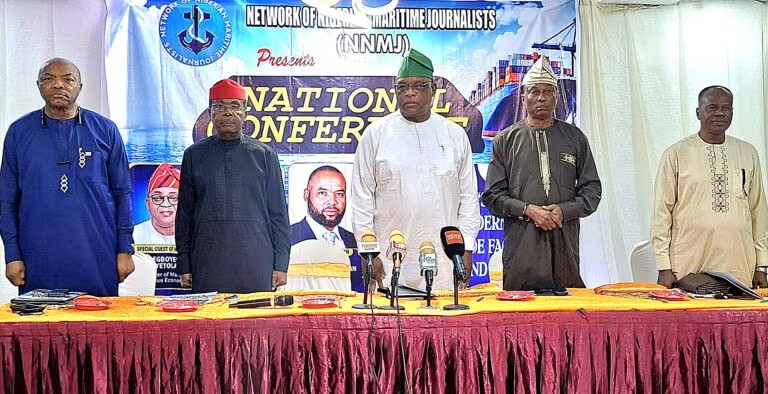
Its resolution was contained in a Communique it issued after a Conference , with the Theme, “Seaport Modernisation, Trade Facilitation and Revenue,” which it organized in Lagos on November 13, 2026.
It stated that port modernization must fully embrace the acquisition of modern equipment , construction of new terminals, efficient movement of cargo, integration of transportation systems, improved regulatory coordination, effective data management and the reduction of operational costs.
The conference urged the Federal Government and relevant agencies to accelerate port modernisation initiatives, ensuring that Nigerian ports meet international standards and are capable of handling increasing cargo volumes, emphasizing the need to improve access roads connecting ports to major commercial centres. It noted that congestion outside the ports often undermines operational improvements within the terminals.
The Communique stated that the maritime industry must embrace technology, transparency and innovation to unlock the enormous economic opportunities available in shipping, port operations, logistics, marine services and international trade.
In the realm of trade facilitation and ease of doing business, the conference identified multiple regulatory procedures, overlapping responsibilities among government agencies and delays in cargo clearance as major obstacles to efficient maritime operations.
It called for stronger inter-agency collaboration among the Nigerian Ports Authority (NPA), Nigerian Maritime Administration and Safety Agency (NIMASA), Nigeria Customs Service (NCS), shipping companies, terminal operators and other relevant stakeholders.
Participants emphasised the importance of implementing seamless cargo clearance procedures that would reduce bureaucratic delays, improve vessel turnaround time and lower the cost of doing business.
The conference also called for the effective implementation of the National Single Window initiative to eliminate duplication of documentation and facilitate the exchange of information among relevant agencies
It tasked relevant authorities to prioritize the development and rehabilitation of roads, rail connections and other transportation infrastructure linking Nigerian ports to major commercial centresa adding that Government agencies operating at the ports should harmonise their procedures to reduce bureaucratic bottlenecks and facilitate faster cargo clearance.
The Conference asked Government and private-sector stakeholders to develop an integrated logistics framework that connects seaports with inland markets, industrial centres and other commercial destinations tasking relevant authorities and operators to explore practical arrangements for feeder services linking Lekki Port with ports in the Delta and Eastern regions to improve cargo distribution and port utilization.
The Communique agreed that NIMASA, NPA and the Nigeria Customs Service should strengthen advance information-sharing arrangements for incoming vessels and their cargoes to improve operational preparedness and regulatory oversight while Customs should explore stronger collaboration and possible operational representation at major overseas ports of origin to facilitate early access to cargo information and improve risk assessment.
On Data transparency, it stated that Maritime agencies should improve the availability, accuracy and accessibility of industry data to support effective planning, research, journalism and policy decisions.
The maritime journalists said Government should introduce policies and incentives that encourage indigenous shipping capacity, vessel ownership and greater Nigerian participation in the maritime value chain while the Federal Government should promote local processing and value addition in the solid minerals sector to increase export earnings and reduce dependence on raw mineral exports.
They said relevant agencies should strengthen monitoring, accountability and technology-driven processes to minimize revenue leakages without creating additional barriers to legitimate trade while Port operators and regulatory agencies should adopt measures to reduce vessel delays, improve operational efficiency and minimize demmurrage and other avoidable charges.
The journalists resolved that professional bodies including NNMJ should intensify capacity-building programmes for maritime journalists, with emphasis on data journalism, investigative reporting, digital media and emerging technologies.
The Communique tasked Maritime agencies and private-sector operators to strengthen their communication channels with the media and provide timely access to accurate industry information.
NNMJ reaffirmed its commitment to promoting responsible maritime journalism, strengthening industry accountability and providing a credible platform for constructive engagement between policymakers, regulators, operators and other stakeholders.
The Network expressed appreciation to the Federal Ministry of Marine and Blue Economy, maritime agencies, industry stakeholders, speakers, sponsors, partners and participants for their support and contributions to the success of the conference.
It also reaffirmed its determination to sustain the momentum generated by the conference through continued professional engagement, industry-focused reporting and advocacy for reforms that will advance Nigeria’s maritime and economic development.