
The Federal Government has resolved to phase out the act of physical examination of containers at the Nigerian seaports, and replace it with the Non-Intrusive Inspection Technology (NIIT) , scanning of goods ,as part of measures , to ensure ports efficiency and competitiveness, as well as enhance trade facilitation .
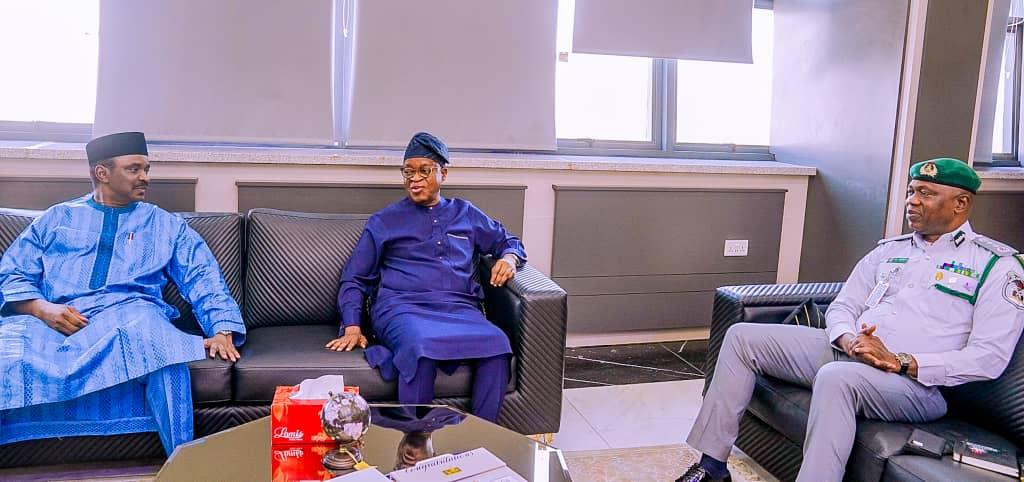
This was decided at a high-powered meeting, between the ministers of Marine and Blue Economy, Adegboyega Oyetola, Transportation, Senator Said Ahmed Alkali and Comptroller General of the Nigerian Customs Service (NCS) , Bashir Wale Adeniyi .
The meeting , which was held at the ministry of Marine and Blue Economy in Abuja , agreed that the use of modern technologies, like scanners, was important to addressing the issue of ports congestion, so as to ensure efficiency and competitiveness.
Consequently, the Customs CG has been mandated to prioritize and enforce the use of scanners at the ports, over traditional physical examination of cargoes, just as they encouraged private investors to come in, and invest in the deployment and maintenance of scanners at the nation’s ports.
In this wise , an mmediate action was endorsed to rectify and optimize all existing scanners at prominent ports such as Apapa, Tincan Island, Onne, and PTML,while the existing mobile scanners will be strategically deployed to facilitate expeditious cargo inspections.
The Managing Director of Nigerian Railway Corporation (NRC), Fidet Okhiria also attended the meeting virtually, while he resolved to ensure the bypass of the fixed scanner at Apapa, during rail construction ,so as to ensure the unhindered progression of scanning process during crucial infrastructure development.
The NRC pledged continued commitment to freight cargoes to Inland container depots/dry ports, a strategic move to alleviate congestion at major ports. Plans were unveiled for the efficient evacuation of containers from Port Harcourt to Aba, with future extensions envisaged for Onne Port.
The meeting advocated the exploration of Public-Private Partnerships, to oversee the installation and maintenance of scanning technology. This collaborative model aims to sustain efficiency and foster innovation in cargo inspection processes.
It is believed that the collaborative synergy witnessed in this meeting underscored the unwavering commitment of the Nigerian government to cultivate a conducive and efficient trade environment, while the anticipated implementation of these resolutions is poised to positively impact on seaports efficiency.