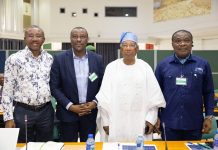



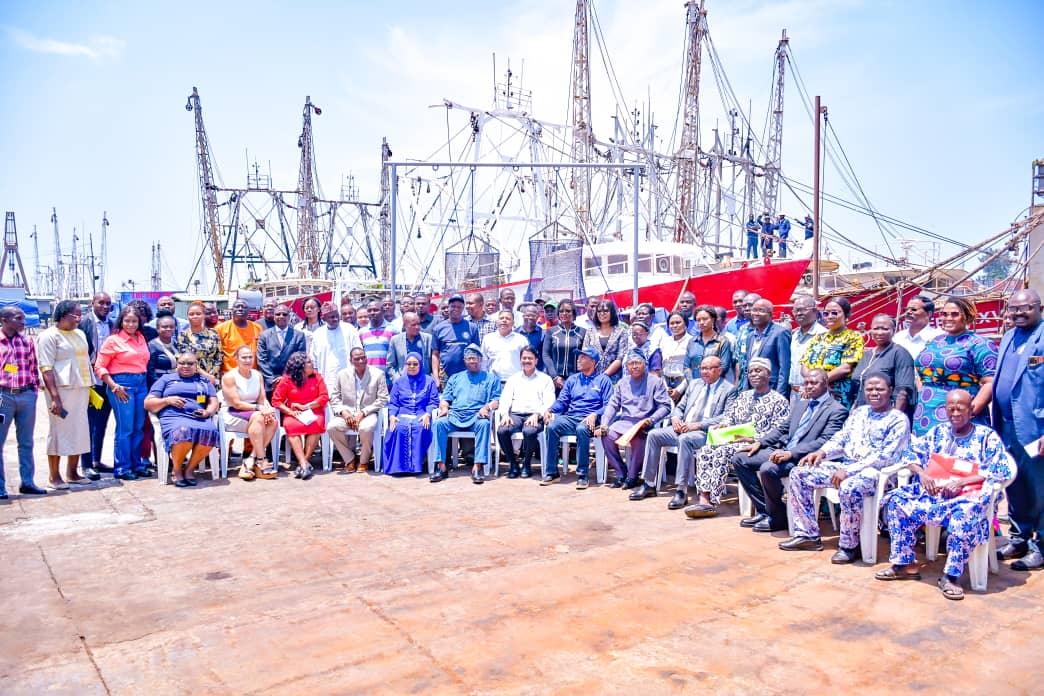
 Government officials and stakeholders at the Workshop on the usage of TED , in Lagos.
Preparatory to receiving the United States (U.S.) verification Team on Turtle Excluder Devices on Wednesday, 11th September, the Federal Government and stakeholders in the fisheries and aquatic industry have expressed their determination to upscale its record fourteen successful recertifications since 1996.
The government and fishery and aquaculture practitioners stated that the TEDs as well as other world standard practices underscore sustainable fishing practices and environmental stewardship.
The Federal Government was represented by the Federal Ministry of Marine and Blue Economy which is in turn represented by the Honourable Minister, Adegboyega Oyetola, CON and his team of Officials while the stakeholders include Fishers, Fish Trawlers Owners, Civil Society Organizations, Federal, States and Local Government Agencies in the business of fishery research and regulations as well as many others.
Since Wednesday, 4th of September, 2024, lasting till the U.S. Verification Team’s scheduled arrival on Wednesday, 10th September, as well as the arrival of the Permanent Secretary of Federal Ministry of Marine and Blue Economy, Olufemi Oloruntola, also, on Wednesday, 4th September, 2024, there have been series of activities lined up to ensure that Nigeria’s commitment to TEDs use is total and the U.S’ recertification which has a number of implications for the economy of the fisheries and aquaculture sector does not fail.
According to a Statement issued by Olujimi Oyetomi ,Director, Press & Public Relations of the Ministry of Marine and Blue Economy, the activities will be rounded off on Friday, 13th of September, 2024.
The Minister of Marine and Blue Economy in his usual meticulous way of allowing due process in the sector, has delayed his arrival to join the officials of his Ministry and the stakeholders in the fisheries sector as well as the U.S TEDs Verification Team of Jarred Milton and Blake Price on Thursday, 5th of September, 2024. By then, the Honourable Minister would have been too sure that the US Team would have inspected, observed, and verified, and the country would be looking forward to recertification for the 15th time.
At the Atlantic Shrimpers Limited’s Jetty (ASLJ) in the Kirikiri Lighter Terminal, Apapa in Lagos on Monday, 9th September, 2024, the stakeholders, in order to ensure that none is left behind in the desire to ensure that all adhered to the global best practice which can ensure the long-term viability and Nigeria’s access to the U.S and European Union markets capped its series of activities with a national workshop.
The national workshop was, however, driven by the Fisheries and Aquaculture Department of the Federal Ministry of Marine and Blue Economy.
At the Workshop on the Usage of TED held in Lagos, it was unravelled that the “device which is a specialized device installed in trawl nets that allow sea turtles to escape while retaining the catch of shrimp and other marine species” was “important for addressing the alarming decline in turtle populations due to bycatch from the unintentional capture of non-target species during fishing activities.”
It was further emphasised that turtles and other aquatic lives have their roles in maintaining the eco-balance and sustainable exploitation of ocean and aquatic resources.”
The Director of Fisheries and Aquaculture at the Federal Ministry of Marine and Blue Economy, Wellington Omoragbon who was on ground as the fore-runner of his Permanent Secretary and Honourable Minister emphasised that the application of TED in the Nigerian ocean will not only bridge the gaps in the biodiversity and ensure the conservation of aquatic ecosystem but will grant wider access of Nigeria shrimps to international market with significant economic impact.
His words: “As we navigate the complexities of our oceans in maintaining biodiversity, supporting complex food web and playing critical role in the cycles of many organisms, from plankton to large marine mammals, the role of TEDs has become increasingly significant, not only in protecting endangered sea turtles but also in enhancing market access for sustainable fishing practices.”
To reveal why Nigeria is serious about TEDs recertification, Wellington Omoragbon submitted that “The implementation of TEDs aligns with global conservation efforts and regulations especially for our trade partnership with the United States of America, with many other countries are now recognizing the importance of sustainable fishing practices leading to the establishment of stricter guidelines and certifications for fisheries.
By adopting TEDs, fishers can demonstrate their commitment to sustainability, opening doors to new markets that prioritize eco-friendly products. This not only enhances their reputation as a marine conserving nation but also ensures better prices and demand for their catch.”
The top Federal Ministry of Marine and Blue Economy Official went further to assert that the use of TEDs can lead to improved fishing efficiency: “By allowing non-target species to escape, fishers can focus on their target catch, reducing waste and increasing profitability. This symbiotic relationship between conservation and economics is essential for the long-term viability of fishing communities”, he emphasized.
Other stakeholders at the TEDs Implementation Workshop spoke in the same vein with Omoragbon.
In her presentation, the Fisheries National Consultant, Mrs Bola Aduke Kupolati submitted that the national workshop on TEDs, will afford the stakeholders to share “insights” which “will contribute to a stronger, more sustainable future for Nigeria’s fisheries.”
Kupolati noted that this year’s inspection arrives at a time of considerable global turbulence: “We face a myriad of challenges including escalating inflation, a cost-of-living crisis, and profound geopolitical conflicts that stretch across regions such as Palestine, Somalia, Sudan, Mali, Niger, and Burkina Faso.
‘’ These global issues are further compounded by climate change and environmental degradation, which have far-reaching impacts on various sectors, including fisheries…In Nigeria, these global challenges resonate strongly with our local circumstances. The rise in fuel prices, coupled with the increased costs of fishing equipment and a volatile exchange rate, have placed immense pressure on our fishing operations.”
The Fisheries National Consultant brought out the challenges on many of our fishers, who she said “are grappling with reduced catches and escalating operational costs, which have significantly affected the sustainability and profitability of their businesses. “The strain on our fishing sector is evident, and it underscores the importance of our ongoing efforts to address these challenges head-on.”
Despite all the identified challenges however, Kupolati like many of the Nigerian stakeholder expressed the belief in Nigerians’ “ability to successfully navigate this TEDs inspection” due to what she identified as “Our collective commitment to sustainable practices and environmental stewardship.”
In a Report put together by Precious Ufuoma Jeremiah, Principal Information officer, Press & Public Relations Department, Ministry of Marine and Blue Economy, Kupolati identified eight-pronged activities that must be undertaken as critical to successful recertification and which have been undertaken:
They include regular and frequent inspections of TED installations and fabrications on shrimp vessels to ensure compliance with regulations; Observations through senior fisheries inspection officers who should be ever-present at jetties to observe the process and ensure that it meets required standards; Continuous refresher training for the fisheries inspectors to maintain high standards of inspection and compliance.
She also talked of reviewing the techniques regularly to improve inspection techniques based on feedback and observations from previous inspections; as well as training net makers, vessel owners, captains, and other relevant stakeholders on the effective use of TEDs.
Kupolati also highlighted facilitating meetings with fleet owners to discuss observations, share insights, and address any issues identified during inspections.
The Fisheries National Consultant further talked on feedback and engagement with inspectors to discuss the strengths and weaknesses of the inspection program and the identification of areas for improvement.
One of the papers delivered at the 9th September, 2024 national workshop on TEDs which further enlightened the audience was delivered by the Akanbi Williams of the Fisheries Department of Nigeria Institute of Oceanography Research, Victoria Island, where an overview of the Nigerian fishing industry was x-rayed as being a vital component of the country’s economy, contributing significantly to food security, employment, and income generation.
“With an extensive coastline (853km) along the Atlantic Ocean and numerous inland water bodies”,
Akanbi revealed that “Nigeria is endowed with rich aquatic resources that support both marine and inland fisheries, contributing about 3-5% to the Gross Domestic Productivity (GDP)”.
He further revealed that the fisheries industry provides direct employment to millions of people, including fishers, fish processors, and traders, with many more dependent on it indirectly.
Akanbi also stated that in terms of food security, fish is a primary source of animal protein for Nigerians, accounting for about 40-50% of the total animal protein intake in the country. This, he said “underscores the critical role the fishing industry plays in ensuring food security.”
Many other researchers and resource persons gingered the swagger of the fishery stakeholders at the national workshop and many more activities are pending when the U.S Inspectors come in; when the Federal Permanent Secretary and the Honourable Minister of Marine and Blue Economy come around for schedule meetings, observation and rounding off. The whole excitement in the marine, blue economy, fisheries, and aquaculture has been palpable all along.