

… Retains ACG Ejibunu as National Co-ordinator
… Badagry- Seme Axis Accounts for 35% of Petrol Smuggled into Lagos/ Ogun Axis
By Shola Fadeyi
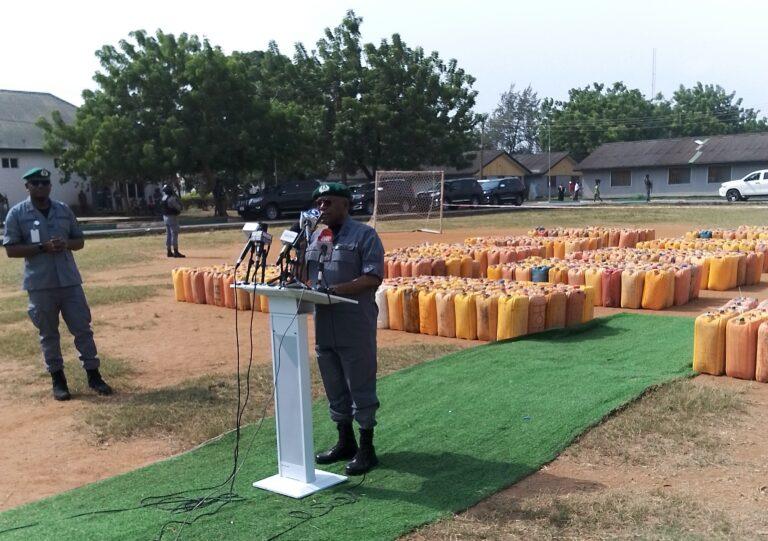
The Nigerian Customs Service (NCS) has said that it has through its Operations Whirlwind three operational zones —Adamawa/Taraba Command, Kwara Command, and Lagos Zone “A”—successfully intercepted a total of 273,670 liters of petroleum products with a combined value of ₦273,940,000, in less than three months of this year.
This is, as it has announced that Assistant Comptroller General (ACG) Hussein Ejibunu ,who has been the National Coordinator of the Task Force since inception will continue to function in that position,despite its current designation as an ACG .
The Customs established the Operations Whirlwind , about a year ago, purposely to prevent smuggling of Petroleum Motor Spirit (PMS) out of Nigeria and to ensure the smooth flow of Petrol in the nation’s economy , with the support of the Office of the National Security Adviser(ONSA) and the co-operation of the Nigeria Midstream and Downstream Petroleum Regulatory Authority (NMDPRA).
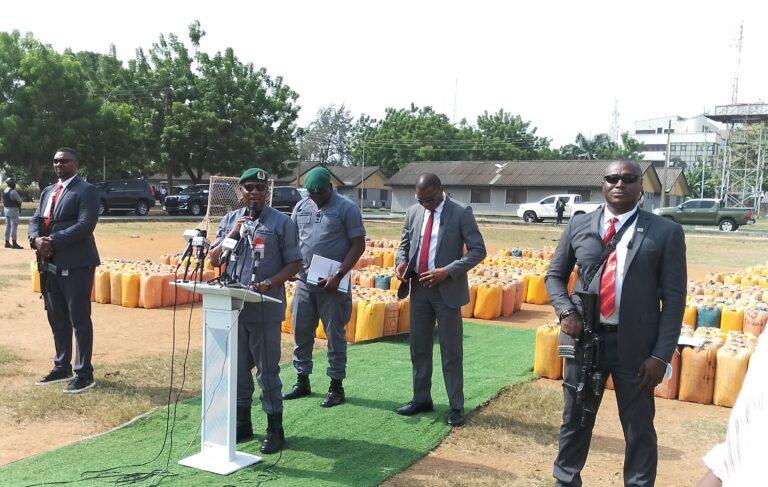
The Customs CG , Adewale Adeniyi announced the figures at the Briefing, he addressed at the Police College , Ikeja, Lagos on Monday , on the fresh seizure of PMS at the Zone A of the Operations Whirlwind ,explaining that the decision to retain Ejibunu as the National Coordinator of the Operations Whirlwind was due to his sterling performance so far on the position and the special experience he possesses , which the post required.
Adeniyi said the seizure figures represent not just statistical achievements but tangible protection of the Nigerian economy and energy security while it showed that the cumulative impact of Operation Whirlwind since its inception has been substantial.
According to Adeniyi, in less than three months, Operation Whirlwind has yielded remarkable results with cumulative seizures of 245,370 liters of Premium Motor Spirit (PMS) valued at NGN 238,140,000—excluding the Zone A seizures for which the briefing was called and those made through regular command structures and Federal Operations Units
The CGC said he has previously presented these operational successes in Adamawa State on January 30, 2025, where the Service’s officers intercepted 199,495 liters valued at 99,495,000, and in Kwara State on February 17, 2025, with additional seizures of 45,875 liters worth N 38,645,000.
Adeniyi stated that the steady momentum of Operation Whirlwind is further demonstrated by the commendable performance recorded in Zone “A”, covering the Lagos/Ogun axis, which serves as both the nation’s commercial nerve center and a high-risk corridor for cross-border smuggling activities due to its strategic location along the western frontier with the Republic of Benin
According to him, following intelligence-driven operations between January 11 and February 23, 2025, vigilant officers under the Operation whirlwind successfully intercepted and seized a total of 28,300 liters of Premium Motor Spirit (PMS) being diverted through various concealment methods and smuggling techniques.
He said the Duty Paid Value (DPV) of these seizures amounted to ₦35,800,000 adding that these tactical operations yielded the following seizures:
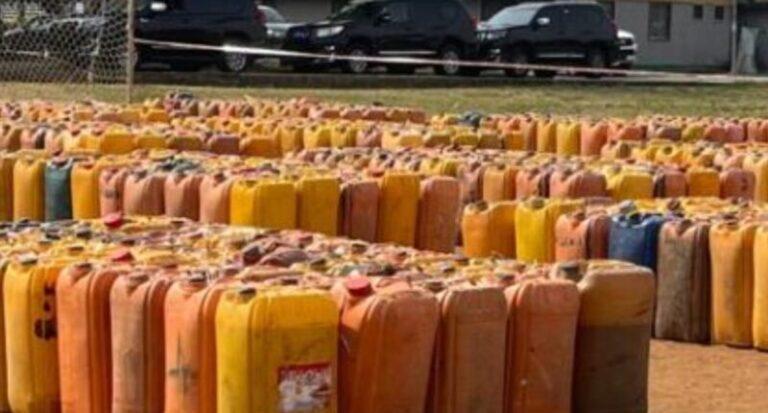
1,132 Jerry Cans of 25 liters each, totaling 28,300 liters,3 vehicles used as means of conveyance, including 1 Toyota Camry with Chassis No. JTDAT1237101922C7, One Volkswagen with Registration No. LAGOS-AAA-928FY and Chassis No. WVW222312LE114785 and One Toyota Camry with Chassis No. 4T1BG22KXXU582542
He said the Customs comprehensive analysis of the pattern of seizures across the Lagos/Ogun axis reveals significant insights into the dynamic smuggling tactics and dominant routes being exploited by these economic saboteurs adding that these seizures were strategically executed at identified smuggling corridors.
Adeniyi said the Customs discovery is that Badagry-Seme Corridor accounted for approximately 35% of total seizures, adding this remains the primary smuggling route with multiple interceptions recorded along Badagry-Seme Road and Badagry waterside.
According to him, the proximity to the Republic of Benin and the complex network of waterways in this area continue to make it a preferred route for smugglers.
He said the Imeko-Afan Axis emerged as a significant secondary corridor with about 25% of total seizures, adding that this area has seen increased smuggling activities, particularly at Oloko Afan, Obada-idieimi, and other remote communities within Imeko-Afan in Ogun State.
The Customs CG stated that the Ilaro-Ojodan Network in Zone A also contributes approximately 22% of intercepted products, saying that the network has become increasingly active with sophisticated smuggling attempts through Ojodan Road and Yewa North areas.
He said the Owode-Ajilete Route is responsible for about 18% of seizures, while it represents another emerging corridor being exploited by smugglers attempting to circumvent the Customs traditional enforcement positions.
Adeniyi observed that unlike previous periods where night-time smuggling dominated, there is now an increased attempts during daylight hours, particularly between 0900hrs and 1400hrs, suggesting a tactical adaptation to Customs night-time enforcement operations.
He said Customs has also noticed the use of specially modified vehicles with concealed compartments and falsified registration documentation, including vehicles registered in neighboring countries, highlighting the transnational nature of these smuggling networks.
According to him, there is also a shift from large-volume single shipments to multiple small-volume movements using smaller containers, strategically timed to coincide with periods of reduced enforcement visibility.
He stated that the successful implementation of Operation Whirlwind highlights the critical importance of strategic inter-agency collaboration in addressing complex national security challenges, adding that this collaborative framework, championed by the National Security Adviser and vigorously supported by President Bola Ahmed Tinubu, characterizes the administration’s proactive stance on security governance.
Adeniyi said the President’s directive on pre-emptive response to early warning signals of security threats has fundamentally transformedthe customs operational approach, enabling seamless intelligence sharing and coordinated tactical responses across security and regulatory agencies.
He stated that the Customs partnership with the NMDPRA and support from ONSA has enhanced the Services operational effectiveness through intelligence sharing, coordinated enforcement actions, and harmonized strategic planning.
Adeniyi promised that the Customs will expand the collaborative framework to include additional stakeholders, particularly the Nigerian Navy for enhanced maritime domain awareness, the Nigerian Security and Civil Defence Corps for critical infrastructure protection, and border communities for improved intelligence gathering.