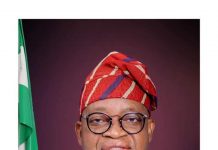


Otunba Babatunde Abdulazeez Mukaila is a household name in the maritime sector .He is a former Sole Administrator and National Secretary of the Association of Nigerian Licensed Customs Agents(ANLCA) and a commentator on burning issues in the maritime sector.
In this interview with SHOLA FADEYI, he talks about wide ranging matters, such as alerts on goods , the proposed Nigerian Ports Economic Regulatory Agency(NPERA) Bill, regulation of maritime sector, the international Cargo Tracking Note (ICTN) among others .However, he condemned high tariff by the Shipping Companies and Terminal operators. Excerpts:-
As for the International Cargo Tracking Note (ICTN) that is to be re- introduced into the Nigerian seaports by the Federal Government , there is no way the scheme when implemented would not add to the cost of clearing goods at the ports , but the prevailing insecurity has made its introduction very important and necessary , particularly with the importation of arms and ammunition into the country.
Security
Since the introduction of the ICTN will Allow the Customs to know the details and characteristics of goods being imported , it will go a long way at boosting security at the nation’s seaports , while it will increase government’s revenue from the Ports, but the issue is that Government needs to ensure that it does not put much additional pressure on the cost of clearing goods at the seaports.
Alerts
Things have changed positively now on the issue of Alerts from the Customs Command . Unlike before, it is now one alert at a time so to say.Once there is an alert from a particular section of the Customs , another one will not come .So it is now about competition between the sectional heads of the Customs , on which Unit to first put an alert .For example , once valuation puts an alert , the compliant Unit will not add another one. I think it has been a good development.
25% Additional Payment
If there is an alert, it may not necessarily end in the issuing of Debit Note or Demand Notice , that must lead to the payment of extra or an additional duty once the importer or the customs agent can prove his point or argue its case. But the real issue is the payment of additional 25 per cent levy which Customs still imposes on goods on which DN has been paid .
The imposition of additional 25 per cent levy is seen as an anomaly and a corruptive act by the Customs , because it is adding to the cost of clearing goods at the Ports, and the Customs hierarchy needs to discontinue the imposition of the levy on goods , particularly when DN must have been paid .
Power
The NPA needs to find solutions to the challenge of Electricity at the Ports so that the terminals can have access to constant power supply particularly for the benefit of preservation of some perishable goods that are imported into the country , before they are cleared out of the ports and for other activities at the terminals.
High Tariff/ Charges
The issue of increase in tariff and imposition of arbitrary charges at the nation’s seaports and maritime sector by the stakeholders especially the terminal operators and shipping companies is one that I would want describe as being criminal.
The implications is that it has been reducing patronage of importers who would have been using their services at the nation’s seaports but who now prefer to take their goods to neighboring countries seaports where the charges are much more less than what prevail in Nigeria.
Terminal Operators
It is rather sad that terminal operators who are increasing tariffs arbitrarily , have proven to even lack the capacity to deliver on the agreement they signed with the Bureau of Public Enterprises(BPE) and the Nigerian Ports Authority(NPA), on behalf of the Federal Government, to provide terminal services. They have refused to invest in equipment to deliver goods to importers, but have indulged in tariff huke.
It is really high time that the Nigerian Shippers’ Council which is supposed to act as the Economic Regulator of the Seaports is conferred with the requisite power to check arbitrary charges of the terminal operators and the shipping companies.
Regulation of Maritime Sector
The coming on stream of the proposed Nigerian Ports Economic Regulatory Agency (NPERA) when the Bill which is still in the National Assembly is passed , would be a very good development that will check the excesses of the terminal operators and the shipping companies agents in Nigeria, in the area of arbitrary and illegal increase in charges.
But as good as the existence of the NPERA will be , it would however be necessary for the provisions of the Bill to be very exclusive in such a way that they would not be in conflict with those of other agencies of government like the NPA, the BPE , which midwifed the Ports Concession, even without the involvement of the Nigerian Shippers’ Council , the Consumers protection agency and even the NSC Act itself .
Nigerian Ports Economy Regulatory Bill
The fear is if the Bill is not well fine- tuned before it is passed , it will lead to a situation where multiple agencies with different mandates would begin to have conflicts among themselves, which would lead to the retrogression of the shipping sector and affect the stakeholders negatively.
If this is not done before the Bill is passed , there may be an issue of the existence of multiple agencies of government with conflicting provisions , which will tend to offer the same services , and thus turn out to be liabilities on the stakeholders as well as impact negatively on the maritime sector instead of making positive contributions.