

.Kicks off Stakeholders Engagements In Lagos
By Shola Fadeyi
The Comptroller General of the Nigerian Customs Service(NCS), Wale Adeniyi, MFR, Phd, has approved the full automation of the Licences and Permits Process of the Service as part of measures to make it faster, more transparent and easier for stakeholders.
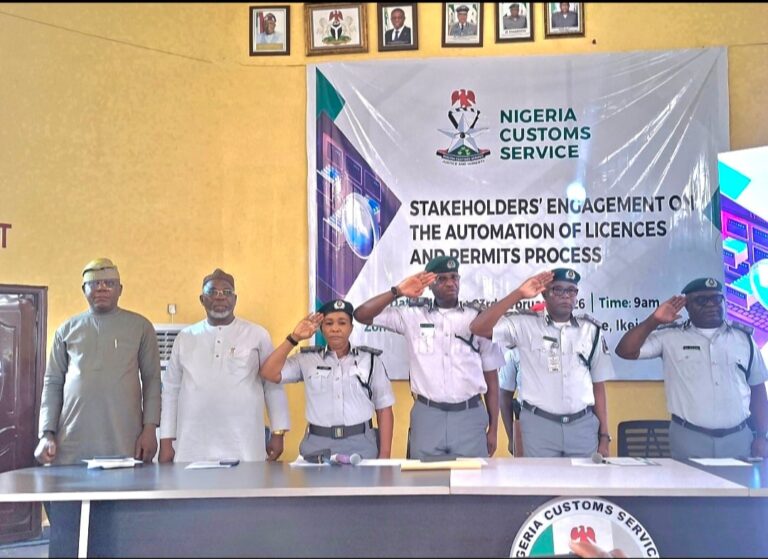
Consequently, it has kicked off in its Zone A headquarters in Lagos, a series of Stakeholders Engagements on the Automation of the Licences and Permits Process, it has proposed to hold in all its Zones , to enhance the understanding of the automation , before the commencement of its implementation .
Speaking at the event in Lagos as a Special Guest of Honour , the Zonal Coordinator for Customs Zone A, Assistant Comptroller General(ACG), Mohammed Babandede said the commencement of the automation of the process will bring to an end the experience of stakeholders in the areas of long queues of paper works and the uncertainty that comes with manual processing.
He said that the goal is to ensure that every stakeholder has a good knowledge of the new automated system before it is implemented.
According to him, for stakeholders, automation of the Licenses and Permits Process means that stakeholders will no longer have to go to any Customs offices to apply for renewal of licence or permit, track the status of their applications real time while applications will be processed faster and can be done from office or even on phones while the process will be same for all , simple and transparent.
He disclosed that for the Service,the automation of the process means better record keeping,reducing the risk of errors that come with manual records, better supervision,and the ability to serve more stakeholders at once without increasing the burden on the officers.
The ACG urged the stakeholders in attendance to take the knowledge acquired at the event back to their associations for their other colleagues ,adding that the more people understand the new process, the smoother the transition will be .
He said with the step that has been taken , Customs is not just automating a process but it is transforming the way it serves the Nigeria’s trade community.
In her welcome address, the Comptroller of Customs, License and Permit Unit, Tariff and Trade Department, Ngozika Anozie said the that the automation of the Licenses and Permits Process is in line with the three points agenda of the CG on Consolidation, Collaboration and Innovation , the need to key into global best practices especially when the NCS CG is the current Chairperson of the World Customs Organization. (WCO).
She said the automation also became necessary because it will enhance the statutory revenue generation duties of the NCS for the fact that fees are paid into the coffers of government with every single licence and permit processed; imports are made with the permits, the clearing processes are stamped with the licences given and obviously, revenue is generated.
According to her , the more licences and permit issued or renewed by Customs , the more the revenue that would be generated for NCS and Nigeria economy.
The Comptroller appealed to the officers whose schedule of duties interface with Licences and Permits Unit to embrace this automation, to enable the CGC , the customs management and all the officers achieve their purpose and add to the other successes of the Customs while she also implored the stakeholders to embrace the automation to enable them reap the benefits.
She assured that the automation process is simple and seamless ,adding that the bond seat officers of various Customs Area Commands have been trained before now for this automation process; but that the Customs is holding the event to refresh their memories on it once more, so that all will be on the same pedestal to enhance the application and utilization of the process..
At the event, the Customs enlightened the stakeholders with video charts on the application of the process while it organized interactive session during which it entertained questions to enhance the understanding of the new arrangement by stakeholders.